
What if our computational frameworks are better at making than remaking?
I've been reading about regenerative design a lot lately, thinking about it from the perspective of a computational designer.
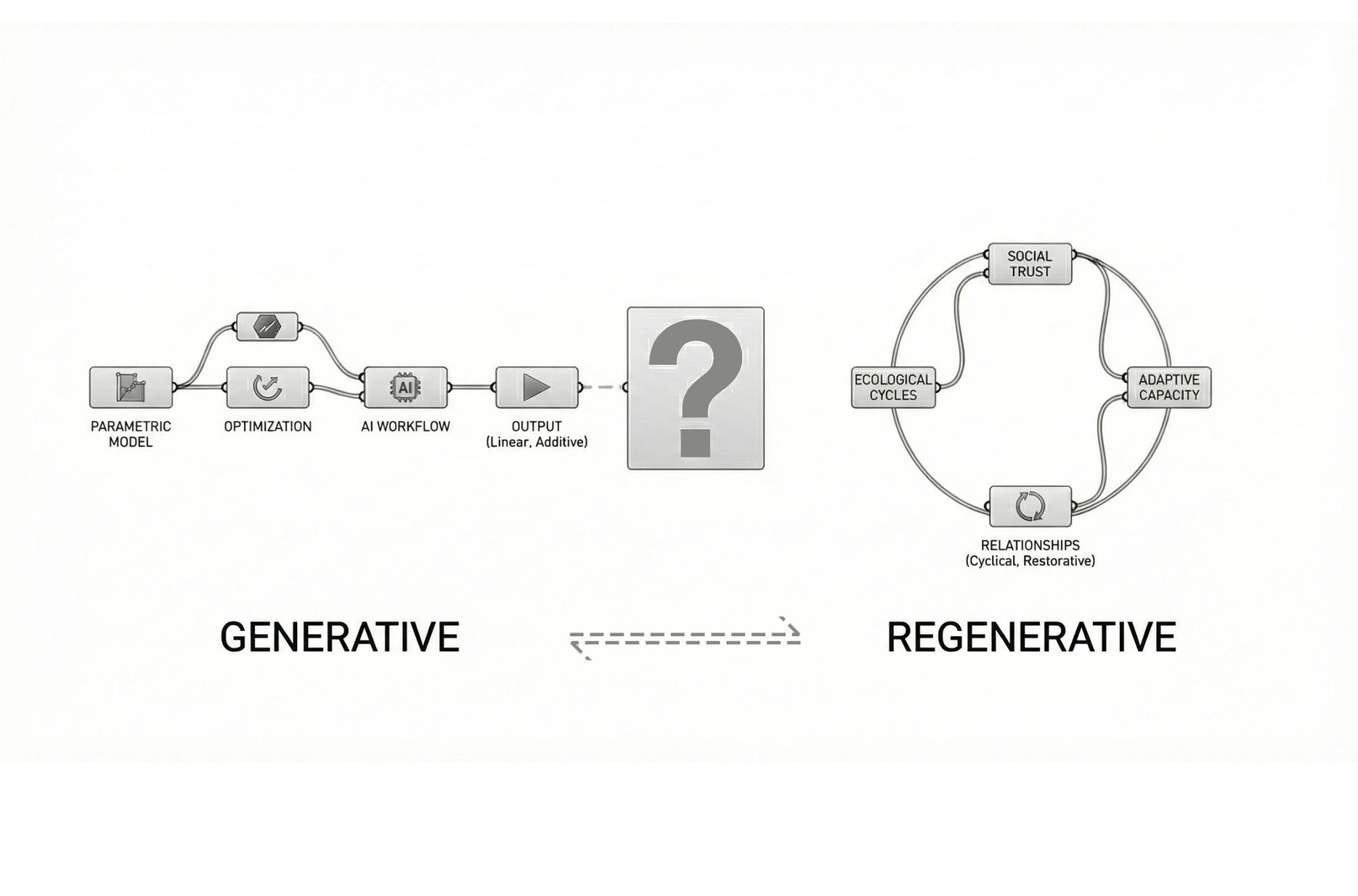
We've built some amazing generative systems. Parametric models producing n number of variations. Optimization algorithms searching solution spaces we couldn't explore manually. Custom workflows generating forms, layouts, entire configurations.
And it's really powerful honestly. I use these tools. Trying to build workflows around them. Not questioning their value at all.
When I dived more into research papers of regenerative systems, I noticed that everything we've built is oriented toward production. Toward generating. Toward adding things to the world.
Regenerative design has been part of how we pursue our domain for decades now. It's so amazingly powerful honestly, when we dive deeper into it, especially with the perspective of a computational designer.
But then I wondered if there can be the computational frameworks for regeneration?
We have generative algorithms. Regenerative ones?
We can parameterize form, density, circulation, solar exposure. Optimize for efficiency, cost, performance.
Wondering if we can we parameterize restoration? Can we optimize for healing?
I don't think we can. Not with what we've built so far I guess.
Generative design works because it's computationally legible. You define parameters, set constraints, set fitness criteria, run optimization, evaluate outputs. It's linear. Additive. You can measure it.
Regeneration doesn't work like that.
Because It's in cycles and doesn't measure things in outputs. More of a capacity that builds over decades, not performance you measure at one moment.
Maybe things that kinda resist being turned into parameters in typical computational sense.
Not because no one tried. (Of course there are research papers on this). But it's just that maybe they're just different from what optimization is built for.
So then I just wonder, maybe the question isn't how we add regenerative thinking to our generative tools.
Maybe it's why our tools only know one direction.
What would regenerative computation even look like? Not generative design with some sustainability metrics added on top. Something where the system is modeling relationships and not producing outputs.
Maybe an entirely different kinda computational approach.
We don't have that. Not really. Yeah, some fragments. Agent-based models. Ecological simulations. But nothing in how we actually practice.
Maybe generation had to come first. Maybe regeneration needs something we haven't built yet.
Or maybe we built a whole field around making and forgot about remaking? :)
Just imagining, how powerful would be the combination of generative and regenerative could be and how it would be as well.
72 ways to use Claude in Architecture Book!